AAPC Certified Professional Coder (CPC) Exam Blueprint and Study Strategy
AAPC Certified Professional Coder (CPC) Exam Blueprint and Study Strategy
The American Academy of Professional Coders (AAPC) Certified Professional Coder (CPC) credential is the gold standard for medical coding in physician office settings. It validates your ability to read complex medical charts and translate provider narratives into accurate alphanumeric codes for billing and compliance. As the healthcare industry faces increased regulatory scrutiny, the demand for certified coders who can prevent revenue leakage and audit penalties remains at an all-time high.
Exam Architecture & Logistics
The CPC exam is a rigorous test of your procedural and diagnostic coding accuracy. Understanding the structural mechanics of the exam is critical for pacing yourself on test day.
- Total Questions: The exam consists of 100 multiple-choice questions.
- Time Limit: You are given exactly 4 hours to complete the test, which equates to approximately 2.4 minutes per question.
- Passing Score: You must achieve a minimum score of 70% to pass and earn the credential.
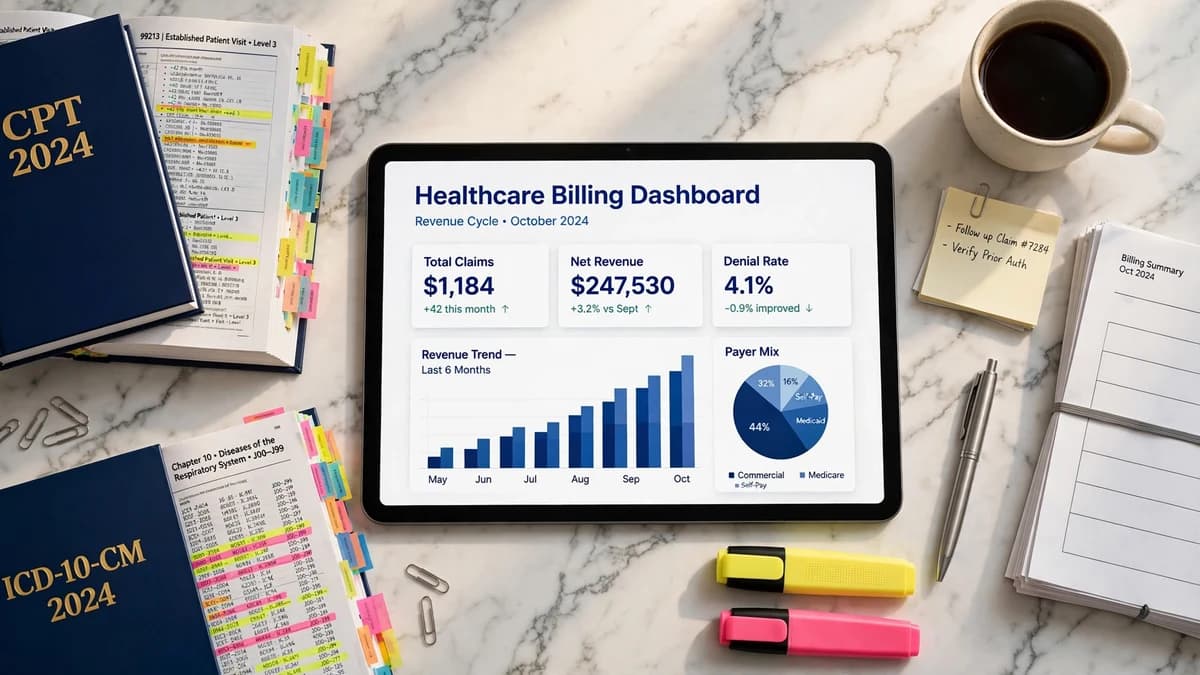
- Open-Book Format: You are required to bring and use the current calendar year's approved coding manuals: the AMA's CPT, ICD-10-CM, and HCPCS Level II. Handwritten notes are allowed within the books provided they pertain to daily coding activities, and you may use tabs to earmark pages.
Deconstructing the 17 Content Domains
The 100 questions are distributed across 17 specific domains. Mastery requires knowing exactly where to look in your manuals and understanding the nuances of each section.
The Surgical Section (36%)
The bulk of the exam tests your proficiency with the CPT surgery guidelines. You will face 6 questions from each of the six major surgical series:
- 10000 Series: Surgical procedures performed on the integumentary system.
- 20000 Series: Surgical procedures performed on the musculoskeletal system.
- 30000 Series: Surgical procedures performed on the respiratory, cardiovascular, hemic, and lymphatic systems.
- 40000 Series: Surgical procedures performed on the digestive system.
- 50000 Series: Surgical procedures performed on the urinary, reproductive, and endocrine systems.
- 60000 Series: Surgical procedures performed on the nervous system.
Additional CPT Categories (22%)
Beyond surgery, you must navigate the remaining procedural categories:
- Evaluation and Management (E/M) Services (6 questions)
- Anesthesia, including time reporting and qualifying circumstances (4 questions)
- Radiology (6 questions)
- Laboratory and Pathology (6 questions)
- Medicine (6 questions)
ICD-10-CM, HCPCS, and Guidelines (15%)
- ICD-10-CM: Code application and the Official Guidelines for Coding and Reporting (5 questions).
- HCPCS Level II: Including modifiers (3 questions).
- Coding Guidelines: Including modifier use (7 questions).
Foundational Knowledge & Compliance (11%)
You must understand the vocabulary and the legal frameworks governing the profession:
- Medical Terminology (4 questions)
- Anatomy (4 questions)
- Compliance and Regulatory: Medicare Parts A, B, C, and D, place of service (POS) codes, National Correct Coding Initiative (NCCI) edits, and HIPAA regulations (3 questions).
Medical Cases (10%)
The exam concludes with 10 practical medical cases. These scenario-based questions require you to extract coding details directly from simulated clinical record documentation and apply CPT, ICD-10-CM, and HCPCS Level II codes accurately.
Strategic Preparation: The Open-Book Advantage
The CPC exam does not test your ability to memorize thousands of codes; it tests your ability to navigate the manuals efficiently under strict time constraints.
- Tab Your Books Aggressively: The AAPC allows you to insert, tape, or glue tabs into your manuals to earmark pages. Create a customized tabbing system for high-traffic areas such as the E/M section, the modifier appendices, and the alphabetical index.
- Master the CPT Index: Do not attempt to guess the numerical code category first. Always start in the alphabetical index at the back of the CPT book, locate the procedure, and then verify the code range in the tabular list.
- Highlight Guidelines, Not Codes: Highlighting every code makes the page unreadable. Instead, highlight the exclusionary notes and parenthetical guidelines that dictate bundling rules and modifier requirements.
- Time Management Discipline: With 100 questions and 240 minutes, you cannot afford to spend 5 minutes on a single anatomy question. If you cannot locate the answer in your manuals within two minutes, select your best guess, mark the question, and move on.
By familiarizing yourself with the 17 domains and optimizing your reference manuals for speed, you will build the confidence required to conquer the CPC exam and advance your medical coding career.
Ready to test your knowledge?
Browse our full catalog of expert-crafted practice exams.