EPA Section 608 Universal Technician Certification Breakdown
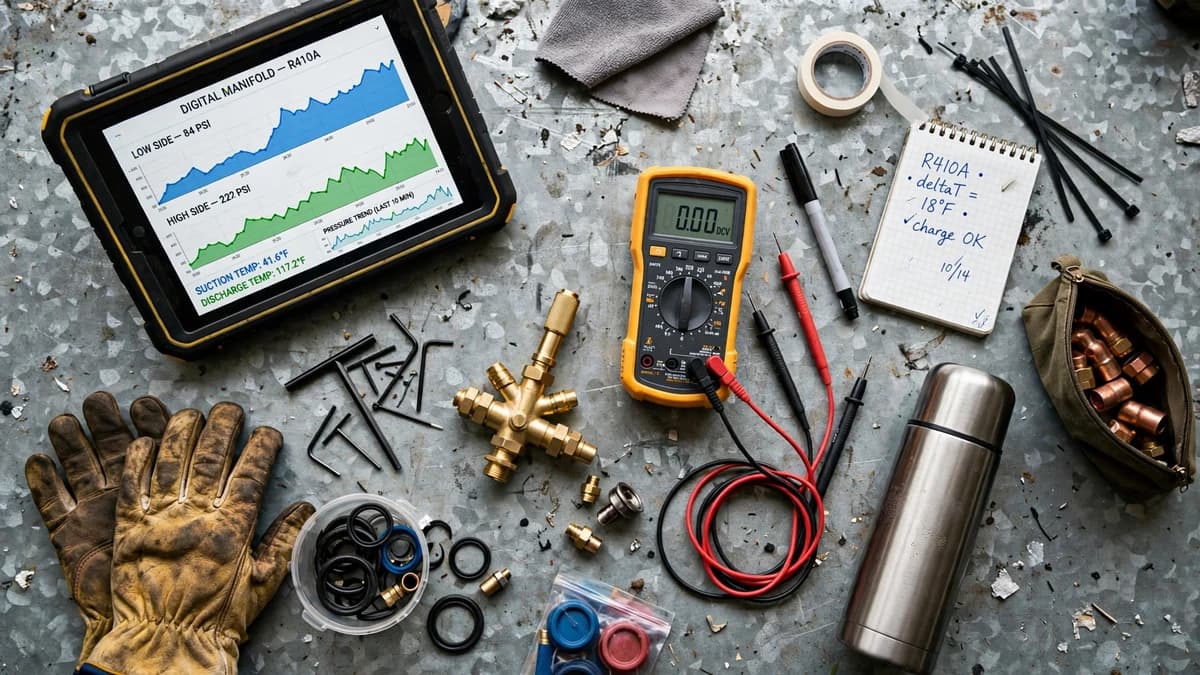
Under Section 608 of the Clean Air Act, anyone who maintains, services, repairs, or disposes of appliances that contain regulated refrigerants must be certified by the Environmental Protection Agency (EPA). It is a federal violation to vent ozone-depleting substances (ODS) or their substitutes into the atmosphere, making this credential a mandatory legal requirement for a career in Heating, Ventilation, and Air Conditioning (HVAC).
While you can earn localized certifications for specific types of equipment, the Universal Certification is the ultimate goal. Achieving Universal status means you are legally cleared to work on any stationary HVAC/R equipment, regardless of size or pressure. This guide breaks down the structure of the exam, the 4 crucial sections you must conquer, and how the recent HFC phasedown impacts the modern testing environment.
Exam Architecture & Logistics
The EPA 608 exam is designed to test your knowledge of safety protocols, legal regulations, and the physical properties of refrigerants.
- The Format: The Universal exam consists of exactly 100 multiple-choice questions.
- The Breakdown: The test is divided evenly into 4 distinct sections: Core, Type I, Type II, and Type III. Each section contains 25 questions.
- The Passing Score: You must correctly answer at least 18 out of 25 questions (72%) in a section to pass it.
- The Universal Rule: To earn the Universal Certification, you must pass the Core section plus all three Type sections (I, II, and III). If you fail one section but pass the others, you only receive the certifications for the sections you passed, and you must retake the failed section later to achieve Universal status.
- Proctoring Requirements: While the Type I exam (which only covers small appliances) can be taken as an open-book, unproctored online test, the Universal Certification requires a formal, closed-book exam taken in the presence of a registered proctor.
Evaluate your readiness with our free EPA 608 diagnostic exam on CertFactory
Deconstructing the 4 Exam Sections
To pass the Universal exam, you must demonstrate technical mastery across the entire spectrum of refrigeration systems.
1. The Core Section (Required for all Types)
This is the foundational section. You cannot hold a Type I, II, or III certification without first passing the Core. It evaluates your knowledge of the overarching environmental laws and safety standards.
- Ozone Depletion: Understanding how chlorine and bromine destroy ozone molecules (ODP) and the greenhouse effect (GWP).
- The Clean Air Act & Montreal Protocol: The legal frameworks, fines for violations (up to $44,539 per day), and the mandatory technician record-keeping rules.
- Safety & Shipping: Navigating DOT regulations for transporting refrigerant cylinders, identifying correct cylinder color codes, and safely handling mildly flammable (A2L) and highly flammable (A3) refrigerants.
2. Type I (Small Appliances)
Type I covers the maintenance of small appliances, defined as pre-assembled units manufactured, charged, and hermetically sealed at the factory with 5 pounds or less of refrigerant. Examples include domestic refrigerators, window AC units, and vending machines.
- Recovery Requirements: You must know the exact recovery percentages required depending on whether the system's compressor is operational or non-operational.
- Equipment Regulations: Understanding the rules regarding self-contained (active) and system-dependent (passive) recovery equipment.
3. Type II (High-Pressure & Very High-Pressure)
Type II covers high-pressure appliances such as residential split-system air conditioners, supermarket refrigeration, and commercial heat pumps. This is often considered the most difficult section due to complex leak repair rules.
- Mandatory Leak Repair Rates: You must memorize the EPA leak rate thresholds. If an appliance contains 50 or more pounds of refrigerant, it must be repaired if it exceeds an annualized leak rate of:
- 30% for Industrial Process Refrigeration (IPR).
- 20% for Commercial Refrigeration.
- 10% for Comfort Cooling.
- Evacuation Levels: Knowing the required inches of mercury (inHg) vacuum you must pull before opening a system for repair, which varies based on the pounds of refrigerant and the type of recovery equipment used.
4. Type III (Low-Pressure)
Type III covers low-pressure appliances, primarily massive industrial chillers that operate below atmospheric pressure.
- Purge Units: Because these systems operate in a vacuum, they are prone to pulling ambient air and moisture into the system. You must understand how purge units remove non-condensables.
- Leak Testing: Recognizing that you cannot pressurize a low-pressure chiller with nitrogen beyond 10 psig during a leak test, or you risk rupturing the rupture disc (which typically fails at 15 psig).
- Evacuation Levels: Understanding the specific deep vacuum requirements (e.g., 25 mm Hg absolute) required for low-pressure recovery.
The Modern Shift: The AIM Act and A2L Refrigerants
The EPA 608 exam is continually updated to reflect the evolving regulatory landscape. The most significant recent shift is the implementation of the AIM Act, which mandates a phasedown of high-GWP Hydrofluorocarbons (HFCs) like R-410A.
As the industry transitions to lower-GWP alternatives, the exam now heavily tests your knowledge of A2L (mildly flammable) refrigerants. You must understand that A2L refrigerants require specialized, spark-proof recovery machines and vacuum pumps. You must also know the regulations regarding the use of Red-colored service ports to identify flammable refrigerants.
Strategic Preparation
- Memorize the Charts: The exam will aggressively test you on the numerical thresholds. Create flashcards for the Leak Rate Percentages, the Required Evacuation Levels (inHg), and the specific dates that ODS production was banned.
- Master the Core First: Because the Core section establishes the baseline vocabulary and legal framework, do not attempt to study Type II or Type III until you are scoring consistently high on Core practice tests.
- Understand the "Why": Do not just memorize that a rupture disc blows at 15 psig; understand why (because low-pressure chiller shells are not built to withstand high internal pressure). Understanding the physics of refrigeration makes recalling the regulations much easier.
Achieving the EPA 608 Universal Certification proves that you are a versatile, environmentally responsible, and legally compliant HVAC technician. By mastering the intricate leak rate calculations, understanding the distinct pressure dynamics of Type I, II, and III systems, and adapting to the new A2L safety protocols, you will secure the foundational credential required to build a lucrative career in the trades.
Ready to test your knowledge?
Browse our full catalog of expert-crafted practice exams.