Journeyman Electrician License Exam: NEC Code Navigation Strategies
The Journeyman Electrician License Exam is the critical threshold that transitions an apprentice into a licensed, independent professional. While electrical theory and hands-on experience are foundational, the exam itself evaluates something highly specific: your ability to interpret and apply the National Electrical Code (NEC) legally and safely.
The most common reason candidates fail is not a lack of electrical knowledge, but a fundamental misunderstanding of the test's design. The exam is an open-book test. It is not designed to measure your rote memory; it is designed to measure your navigation speed under strict time constraints. If you do not know how to translate a scenario into a specific index keyword and locate the corresponding code article within two minutes, you will run out of time.
Exam Architecture & Logistics
Licensing exams vary slightly by state and municipality, but most jurisdictions adhere to a standardized format provided by testing agencies like PSI or Pearson VUE.
- Total Questions: You will typically face an exam consisting of 80 to 100 multiple-choice questions.
- Time Limit: The standard time limit ranges from 4 to 5 hours. This allows for roughly 2.5 to 3 minutes per question.
- Passing Score: Most jurisdictions require a minimum score of 70% to 75% to pass.
- Content Breakdown: Exams generally distribute questions across four major domains:
- NEC Code Applications (60–70%)
- Electrical Theory & Calculations (15–20%)
- Load Calculations & Service Sizing (10–15%)
- Safety Practices & Blueprint Reading (5–10%)
Evaluate your readiness with our free Journeyman Electrician diagnostic exam on CertFactory
Deconstructing High-Yield NEC Chapters
The NEC is over 900 pages long, but the Journeyman exam disproportionately targets specific foundational chapters. You must have an expert understanding of the layout of these key areas.
Chapter 2: Wiring and Protection
This chapter dictates how to protect an electrical system from faults and overloads.
- Article 250 (Grounding and Bonding): This is historically the most complex and heavily tested article on the exam. You must understand equipment grounding conductor requirements, the difference between grounding and bonding, and how to properly size grounding electrode conductors using the tables in this section.
- Article 210 (Branch Circuits): Familiarize yourself with required receptacle outlets in dwelling units, GFCI/AFCI protection rules, and branch circuit ratings.
Chapter 3: Wiring Methods and Materials
This chapter focuses on the physical installation of conductors and raceways.
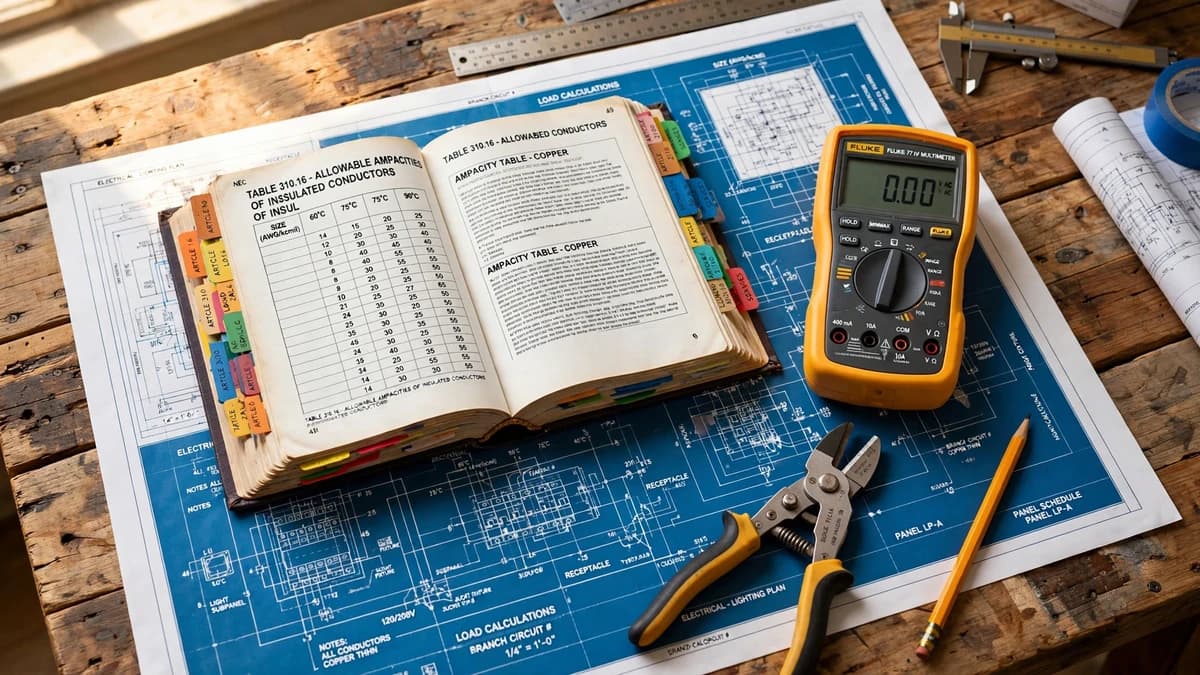
- Article 310 (Conductors for General Wiring): You must navigate the ampacity tables (e.g., Table 310.16) to size conductors correctly. Pay close attention to the adjustment factors for ambient temperature and having more than three current-carrying conductors in a raceway.
- Article 300 (General Requirements): Understand burial depths, securing and supporting requirements for cables, and protection against physical damage.
Chapter 4: Equipment for General Use
- Article 430 (Motors, Motor Circuits, and Controllers): This article is heavily tested. You must be able to use the tables at the end of the article (e.g., Table 430.250) to find full-load currents for three-phase motors, rather than relying on the motor's nameplate data for sizing conductors and short-circuit protection.
Chapter 9: Tables
Chapter 9 is purely reference data, but it is critical for calculations. You will use these tables to answer conduit and box fill calculation questions.
Core Calculations You Must Master
While code lookup makes up the bulk of the test, mathematical calculations will dictate your final margin of success. You must be able to execute the following calculations flawlessly:
- Load Calculations: You must know how to perform standard and optional load calculations for single-family dwellings, multi-family units, and commercial services. This requires applying demand factors for lighting, ranges, and dryers.
- Conduit and Box Fill: You must calculate the maximum number of conductors permitted in a specific size of conduit or determine the minimum size box required for a given number of wires and devices.
- Ohm's Law and Voltage Drop: Expect questions testing basic AC/DC theory, series and parallel resistance circuits, and single-phase and three-phase voltage drop formulas.
Code Navigation Strategies
Your primary tool in the exam room is your tabbed and highlighted copy of the NEC.
- The Art of Tabbing: Do not just rely on store-bought tabs. Customize your tabbing system to flag high-traffic areas. Tab Chapter 2 for protection, Chapter 3 for wiring methods, and Chapter 4 for equipment. Specifically, tab the conduit fill tables, motor data tables, and the ampacity tables.
- Master the Index: If the Table of Contents is your map, the Index is your GPS. The key to passing is translating a complex word problem into a single search term. If a question asks about "flexible metal conduit," go straight to "Conduit, Flexible Metal" in the index rather than blindly flipping through Chapter 3.
- Identify the Keywords: Train your brain to isolate the most important words in the question stem (e.g., "continuous load," "dwelling unit," "over 600 volts"). These keywords instantly dictate which chapter or article you should reference.
Passing the Journeyman Electrician exam is an exercise in applied logic and strategic navigation. By familiarizing yourself with the core layout of the NEC, heavily tabbing your highest-yield tables, and practicing load calculations until they become muscle memory, you will walk into the testing center prepared to claim your license.
Ready to test your knowledge?
Browse our full catalog of expert-crafted practice exams.