Next Generation NCLEX-RN (NGN): The Definitive Guide to Clinical Judgment and Scoring
For decades, nursing licensure examinations prioritized the rote memorization of lab values, pharmacological contraindications, and rigid procedural steps. However, data collected by the National Council of State Boards of Nursing (NCSBN) revealed a critical gap: entry-level nurses were frequently involved in clinical errors not due to a lack of factual knowledge, but due to a failure in clinical decision-making.
To bridge this gap, the NCSBN completely overhauled the licensure exam, introducing the Next Generation NCLEX (NGN). This modern iteration fundamentally changes how nursing competency is evaluated. The NGN does not simply ask what you know; it evaluates how you think. It demands that candidates synthesize complex, unfolding client data, anticipate complications, and prioritize life-saving interventions in real-time.
For nursing students preparing for the 2026 exam cycle, understanding the architecture of the NGN—specifically the Clinical Judgment Measurement Model (NCJMM) and the polytomous scoring system—is just as important as mastering pathophysiology. This guide deconstructs the mechanics of the modern NCLEX-RN, providing a strategic blueprint for your final phase of preparation.
Exam Architecture & Computerized Adaptive Testing (CAT)
The NCLEX-RN utilizes Computerized Adaptive Testing (CAT) to measure a candidate's nursing ability with maximum efficiency. Unlike traditional fixed-length exams, the CAT engine recalibrates the difficulty of the next question based on your previous answer. If you answer correctly, you receive a slightly harder question. If you answer incorrectly, you receive an easier one. The goal is to pinpoint your exact level of ability relative to the passing standard.
The logistics of the NGN exam are strictly defined:
- Exam Length: Candidates will face a minimum of 85 items and a maximum of 150 items.
- Time Limit: You are allotted a maximum of 5 hours to complete the examination, which includes all introductory screens and optional breaks.
- Pretest Items: Of the minimum 85 items, 15 are unscored pretest items used for future exam development. You will not know which items are scored and which are unscored.
- Case Studies: Every candidate, regardless of where their CAT engine stops, will receive a minimum of three unfolding case studies. Each case study contains six items, totaling 18 case study questions that directly evaluate clinical judgment.
Evaluate your clinical judgment with our free NGN diagnostic exam on CertFactory
The Core of the NGN: The Clinical Judgment Measurement Model (NCJMM)
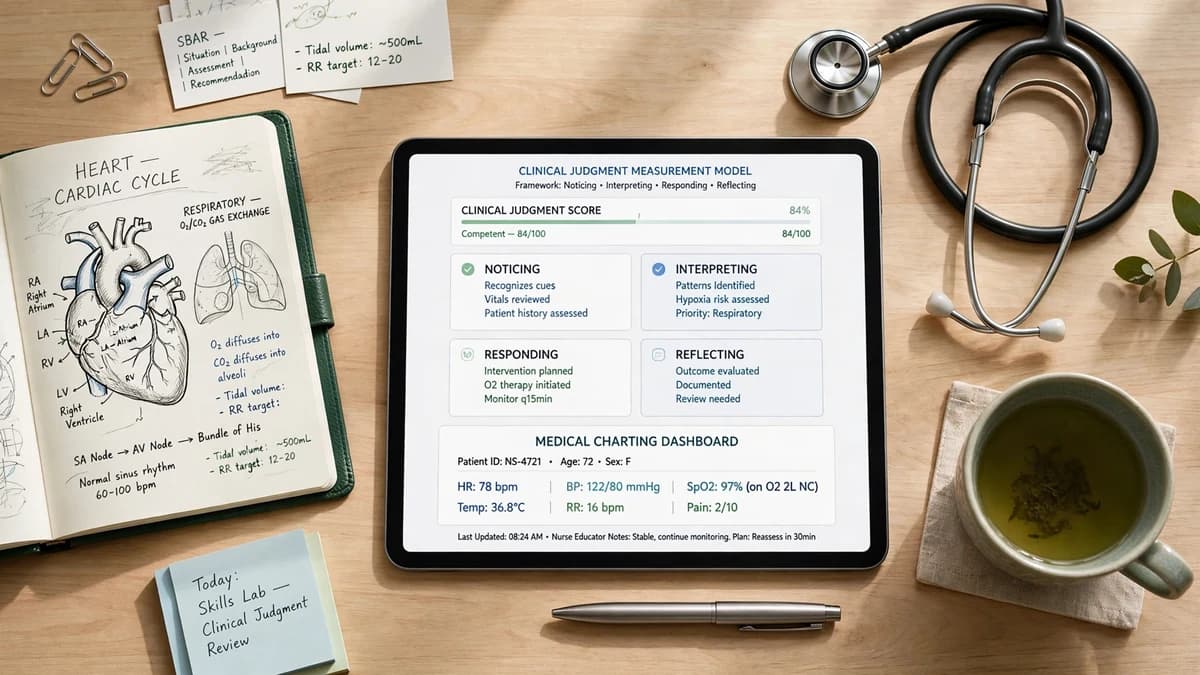
The most significant addition to the NGN is the NCJMM. This is a six-step cognitive framework designed to measure how a nurse processes information and makes safe client care decisions. You must intuitively understand these six cognitive skills, as the unfolding case studies are mapped directly to them in chronological order.
- Recognize Cues: Identifying relevant client information from various sources (e.g., vital signs, lab results, patient history). What matters most in this specific scenario?
- Analyze Cues: Connecting the recognized cues to the client's clinical presentation. What could these specific symptoms mean?
- Prioritize Hypotheses: Evaluating and ranking hypotheses according to priority. Which condition is the most critical or immediately life-threatening?
- Generate Solutions: Identifying expected outcomes and determining a set of appropriate interventions. What are the best actions to address the prioritized hypothesis?
- Take Action: Implementing the highest priority interventions from the generated solutions. What action must you perform immediately?
- Evaluate Outcomes: Comparing observed outcomes against expected outcomes. Did the intervention work, or is the client deteriorating?
Deconstructing the Next Gen Item Types
To accurately assess the six steps of the NCJMM, the NCSBN introduced complex new item types that mirror electronic health record (EHR) charting and real-world clinical analysis.
Unfolding Case Studies
You will be presented with a split-screen interface. The left side features a client's medical record, including nursing notes, flowsheets, lab results, and provider orders. This information will update and "unfold" as the scenario progresses. The right side contains six sequential test items that walk you through the NCJMM process for that specific client.
Bowtie Items
Bowtie questions are standalone items that test multiple cognitive skills simultaneously. You are presented with a clinical scenario and a drag-and-drop interface shaped like a bowtie. You must drag the correct "Condition" into the center, the appropriate "Actions to Take" into the left side, and the "Parameters to Monitor" into the right side.
Matrix / Grid Items
These items present a grid where you must evaluate multiple client findings or interventions simultaneously. For example, you may be given a list of five client symptoms and asked to check boxes indicating whether each symptom is a sign of hyperthyroidism, hypothyroidism, or both.
Extended Multiple Response
Standard "Select All That Apply" (SATA) items have been modernized. Extended Multiple Response items may require you to select a specific number of options (e.g., "Select the top 3 interventions") or evaluate a long list of potential actions where any number of options could be correct.
The Paradigm Shift: Polytomous (Partial Credit) Scoring
Historically, NCLEX SATA questions were scored on a harsh "all-or-nothing" basis. If an item had three correct choices and you selected two, you received zero points. The NGN introduces polytomous scoring—partial credit—which provides a much fairer assessment of a candidate's clinical knowledge.
You must understand the three distinct scoring models used on the exam:
1. 0/1 Scoring
Used for standard multiple-choice questions. You earn 1 point for the correct answer and 0 points for an incorrect answer. There are no deductions.
2. Plus/Minus (+/-) Scoring
Used for Extended Multiple Response and Matrix items. You earn 1 point for every correct option you select. However, you lose 1 point for every incorrect option you select. The total score for the item is the sum of the positive and negative points. The lowest possible score for an item is zero (you cannot receive a negative score for a question).
Strategic Takeaway: Because you are penalized for guessing incorrectly, you should only select options you are confident are correct. Blind guessing on SATA questions will actively destroy your score.
3. Rationale Scoring
Used for questions that establish a cause-and-effect relationship, often formatted with drop-down menus (e.g., "The nurse should administer [Action] because the client is experiencing [Condition]"). You must get both parts of the statement correct to earn full credit. If you get one part wrong, the entire logic chain is broken, and you may receive zero points depending on the specific item's rule set.
Executing Your Preparation Strategy
Passing the Next Generation NCLEX requires a shift in how you study. Reading textbook chapters and memorizing pharmacology flashcards is no longer sufficient.
- Practice with High-Fidelity EHR Simulators: You must become comfortable navigating complex interfaces. Practice reading electronic medical records, switching between tabs (History, Vitals, Labs), and synthesizing that data quickly.
- Prioritize the "Airway, Breathing, Circulation" (ABC) Hierarchy: When answering "Take Action" questions, always rely on foundational nursing principles. Assess before you intervene, prioritize systemic issues over local issues, and always address acute threats to airway and breathing before chronic concerns.
- Deconstruct Your Mistakes via the NCJMM: When you review missed practice questions, identify exactly where your cognitive process failed. Did you miss a critical lab value (Failed to Recognize Cues)? Did you misinterpret the symptom (Failed to Analyze Cues)? Or did you apply the wrong intervention (Failed to Take Action)? Pinpointing the cognitive failure allows you to correct the underlying logic.
The Next Generation NCLEX-RN is a rigorous evaluation, but it is ultimately a fairer reflection of the clinical reasoning you have developed throughout nursing school. By mastering the six steps of the NCJMM, adapting to the new partial-credit scoring models, and practicing with realistic case studies, you will prove your readiness to provide safe, highly competent client care.
Ready to test your knowledge?
Browse our full catalog of expert-crafted practice exams.