Agile, PMP, or PRINCE2? Choosing the Right Project Management Certification
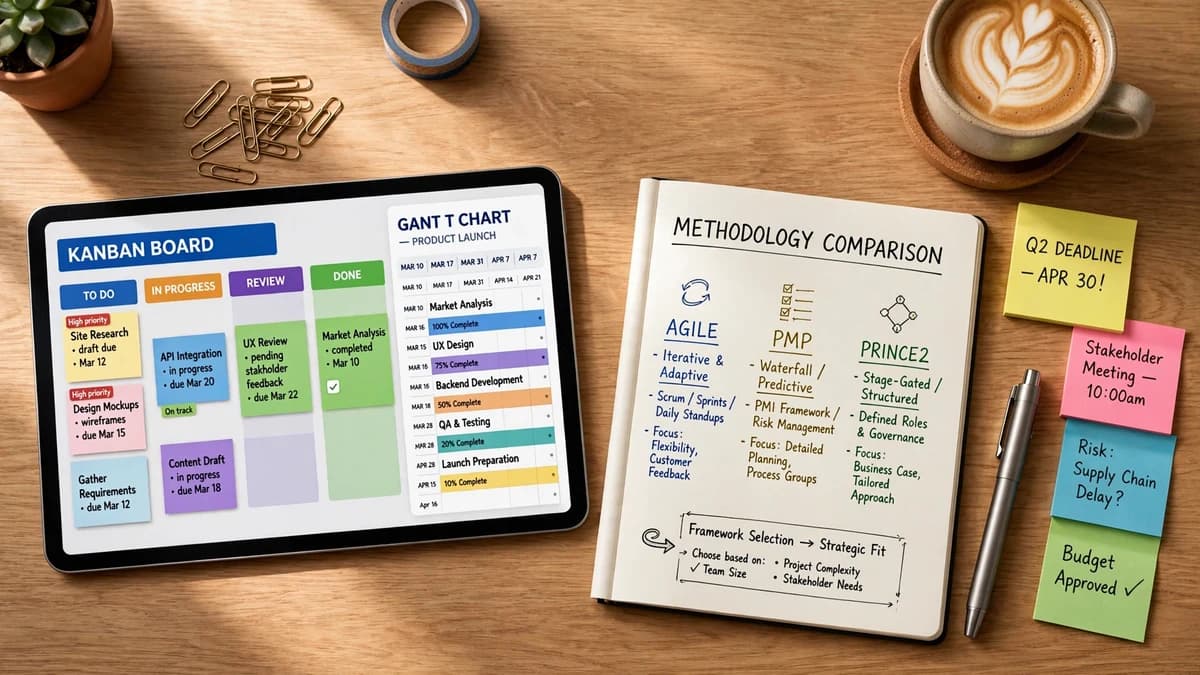
The project management landscape has fundamentally shifted. In the modern project economy, project management is no longer viewed merely as a back-office tracking function; it is recognized as a primary driver of corporate strategy. As organizations face rapid digital transformation and hybrid work environments, the demand for certified professionals who can navigate complex deliverables has surged.
Choosing the right project management certification is a critical career decision. While the Project Management Professional (PMP) and PRINCE2 are globally respected, their DNA is fundamentally different. The core dilemma is not simply about which acronym looks better on a resume; it is about aligning your chosen framework with your geographic location, your industry, and your personal leadership style. This guide dissects the "Big Three" pathways—PMP, PRINCE2, and pure Agile—to help you navigate your certification journey.
The PMP: The Global Standard for Leadership
The Project Management Professional (PMP) certification, administered by the Project Management Institute (PMI), is a descriptive body of knowledge. It does not tell you exactly how to run a project step-by-step; instead, it provides a comprehensive toolkit and validates your individual competency and leadership agility. The PMP standard defines the project manager as a servant leader whose primary focus is empowering the team and removing organizational impediments.
The 2026 updates to the PMP Exam Content Outline (ECO) radically modernized the certification, ensuring it aligns with how hybrid project management is actually practiced today.
- The 2026 Domain Weightings: The exam evaluates candidates across three domains: People accounts for 33%, Process accounts for 41%, and Business Environment accounts for 26%.
- Agile Integration: Approximately 60% of the exam now reflects agile and hybrid approaches. Only about 40% of the exam remains focused on traditional predictive methodologies.
- Exam Format: The test consists of 180 questions that must be completed in 240 minutes.
- Prerequisites: Candidates must possess 36 to 60 months of actual project management experience, depending on their educational level. Furthermore, 35 hours of formal project management education are required to sit for the exam.
- Market Value: The PMP is the dominant force in North America and Australia. In the United States, PMP certification provides a 24% salary premium, with senior roles commanding substantial compensation.
PRINCE2: The Framework for Organizational Governance
PRINCE2 (Projects IN Controlled Environments) is fundamentally different from the PMP. Managed by Axelos, PRINCE2 is a prescriptive framework that provides a detailed, step-by-step manual on how to run a project. Rather than focusing purely on the individual manager's skills, it emphasizes structured governance, clearly defined roles, and robust documentation.
- Core Architecture: The PRINCE2 framework operates on 7 Principles, 7 Themes, and 7 Processes.
- Governance Model: Unlike PMP, which assigns primary responsibility to the project manager, PRINCE2 places accountability on the Project Board. The project manager executes the tasks according to the authority granted by the Board.
- Accessibility: The PRINCE2 Foundation exam has no prerequisites, making it highly accessible for beginners. To take the Practitioner exam, candidates must first pass the Foundation level.
- Global Reach: It is widely adopted across the United Kingdom, Europe, Australia, and within government or public sector organizations.
- Modernization: The recent PRINCE2 7 update has closed the gap with agile methodologies by explicitly incorporating digital delivery and agile-compatible tailoring.
Dedicated Agile Certifications (PMI-ACP, Scrum Master)
While the PMP has heavily integrated agile concepts, dedicated Agile certifications serve a distinct purpose. Agile describes iterative ways of planning and delivering work that prioritize regular feedback and allow teams to quickly respond as project requirements evolve.
Certifications like the PMI Agile Certified Practitioner (PMI-ACP) or Certified ScrumMaster (CSM) are targeted specifically at software development, product management, and innovation-heavy sectors. If you operate exclusively in continuous integration environments where rigid governance would stifle product delivery, a pure Agile certification provides the focused tactical training required for daily sprint execution.
Choosing Your Certification Path
Deciding between these frameworks requires a strategic look at your current experience and your future career trajectory.
- Experience Level: If you have over three years of leadership experience, the PMP offers immense global recognition and strong career growth. If you are a beginner, the PRINCE2 Foundation is the better starting point due to its lack of prerequisites and highly structured framework.
- Geography and Industry: The PMP is globally recognized but maintains the strongest demand in North America, the Middle East, and multinational corporations. PRINCE2 is the standard for the UK, European markets, and highly regulated industries such as government and construction.
- Methodology vs. Knowledge Base: If your organization relies on a rigid project board structure and values strict compliance, PRINCE2 is non-negotiable. If you need a versatile toolkit that adapts to diverse delivery methods across various industries, the PMP is the superior choice.
The ultimate differentiator in the 2026 market is dual certification. Combining the PMP and PRINCE2 signals to employers that you possess both the servant leadership skills of an agile practitioner and the disciplined governance capabilities required to protect organizational investments.
Ready to test your knowledge?
Browse our full catalog of expert-crafted practice exams.